
How does research aid in conservation?
The field of conservation comprises a wide breadth of actions, not to mention policies, laws, customs, traditions, etc. It’s easy to envision the conservation events and breakthroughs that make the news headlines, e.g., “New nature preserve protects 1 million acres of native prairie” or “First wild California condor chick hatched since 1985” or “Conservationists rescue 400 critically endangered monkeys from poachers”. But there is another aspect of conservation that is less flashy, and therefore easily overlooked—basic scientific research.
Just as conservation efforts exist in many varieties and scopes, the realm of research related to conservation is no different. For example, some of my research chases the basic information that one can find in a field guide or on a sign at a zoo. What does it eat? Where does it live? How does it reproduce? But what shall we do if that basic information simply is unknown? For example, which species is before us here? It is arguably difficult to conserve a species that is not known to exist.
Robert Hill, Curator of Herpetology at Zoo Atlanta, led the effort to formally describe not one, but multiple, new-to-science species of horned frogs in Panama (all of which are critically endangered). In another example, my fieldwork in Mexico and Central America has revealed that there previously were no less than seven species of toads masquerading, unrecognized by science or the IUCN Red List, under the name of the widespread and fabulously abundant toad (Gulf Coast toad, Incilius valliceps). Gulf Coast toads need no conservation protections at this time, but each of the other seven species—each of which now finally has its own scientific name and identity—are all endangered. Now that they are taxonomically recognized, conservation planners include them in their strategies. Biogeographic research, also field-based, determines where species live and, just as importantly, where they do not live, as well as their habitat associations.
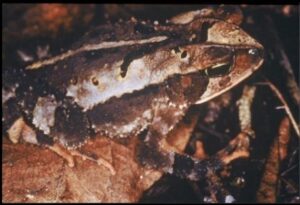
The Oaxacan spiny toad, we now know, lives only on two mountain slopes in the State of Oaxaca in southern Mexico, and on those slopes it is entirely restricted to pristine rain- and cloud-forests; they do not tolerate any habitat distresses at all. Furthermore, they have a very unusual breeding cycle in which they breed in streams during the regional dry season (October to May), which is exactly backwards with regards to “typical toads” that breed in puddles in the wet season. Consequently, conservationists know now to conduct their surveys to monitor population status in December rather than July. Based on this research, conservationists now have the basic information necessary to have this endangered toad incorporated into regional conservation plans, i.e., we know it exists, we know where it lives, and we know what sorts of habitats it needs to breed successfully.
Relatedly, when zoological breeding programs are identified as a necessary means of conserving endangered species, it is zoo curators and staff that are tasked with developing the husbandry protocols to successfully breed them; Zoo Atlanta has led some of these efforts for endangered frogs. In other words, determining what they need in terms of diet, temperature, humidity, etc. Be there no doubt that animal husbandry is a true art, and a crucially necessary art when a species now in need of conservation-breeding efforts has never been maintained under zoological care before.
In the last two decades, multiple emerging infectious diseases have become recognized as very serious threats to biodiversity. An epidemic of disease can sweep through a protected area, eradicating local populations, even to the point of species-level extinction, essentially nullifying the valid efforts to protect local habitats from other, more familiar threats like poaching, contamination, or habitat destruction (legal or illegal). Unfortunately, the list of newly discovered wildlife diseases that can decimate populations keeps getting longer as globalization of travel and trade routes continue to bring pathogens into naïve communities of wildlife. Examples include white-nose fungus in bats, wasting diseases in corals and seastars, the amphibian chytrid fungus, Asian lungworms in U.S. snakes, and the list sadly goes on much longer.
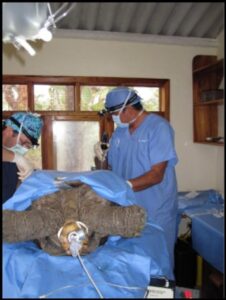
Wildlife diseases require the skills of veterinarians, and the best-qualified vets for such situations often are at zoos owing to their extensive experience across a very broad range of species and their diseases. Zoo veterinarians often are called as first-responders in wildlife-disease emergencies, and zoo vets often lead the research efforts to discover, describe, and develop treatments for diseases that are directly affecting wildlife. The amphibian chytrid fungus has led at least 50 formerly abundant species to extinction, and the fungus—which remained mysterious and elusive for years—was finally discovered by veterinarians at Smithsonian’s National Zoo. I am not a veterinarian, but my collaborative research identified the major spatial and temporal pathways that the fungus was following during the height of the pandemic, thus giving conservation planners a map and timetable to use in plotting their strategies. Dr. Sam Rivera at Zoo Atlanta has been working with colleagues for years on the dreadful incidence of facial cancers in wild sea turtles in the Caribbean, as well as discovering new species of parasites from endangered turtles rescued from illegal trade, and truly innovative veterinary techniques to allow release of Galapagos tortoises back into native habitat. Dr. Kate Leach at Zoo Atlanta, our Herpetology Department, and I are working right now on discovering the identity of a mysterious (and sometimes fatal) previously unknown virus that affects wild and captive sidewinder rattlesnakes (Crotalus cerastes). This is a work-in-progress, as we still do not know if other species are affected or how geographically widespread the virus is among sidewinder populations (or other species). The few existing wild populations of the golden lion tamarin (Leontopithecus rosalia) recently suffered an epidemic of yellow fever, and researchers at Zoo Atlanta documented the toll this took on this endangered species and modeled different pathways to recovery.
The staff at modern AZA-accredited zoos include diverse groups of animal biologists that contribute to many of the essential needs of conservation efforts, including discovering and documenting biodiversity, discovering the distributions and habits of species, developing husbandry protocols for successfully maintaining and breeding them under zoological care, discovering and combating infectious diseases that threaten species with decimation or extinction, and researching the basic needs and functions of animals from diet to reproductive biology. There is a lot going on behind-the-scenes in the research departments at modern zoos, and these myriad activities directly inform, and therefore improve, conservation initiatives for endangered species. I’m very proud to say that Zoo Atlanta has long been a leader and major contributor in research programs that inform and strengthen conservation efforts.
References and suggested readings (Zoo Atlanta staff in bold):
- Aguilar, L.A., K. Leach, M.K. Watson, C. Wang and S. Rivera. 2022. Medical management of open pyometra in a giant panda (Ailuropoda melanoleuca). Veterinary Record Case Reports 10:e300.
- Bursey, C. R., and S. Rivera. 2009. New species of Falcaustra (Nematoda: Ascaridida: Kathlaniidae) in the impressed tortoise, Manouria impressa (Testudines: Testudinidae). Comparative Parasitology 76:141–148.
- Dietz, J. M. et al. (including J. Mickelberg). 2024. Golden lion tamarin metapopulation dynamics five years after heavy losses to yellow fever. American Journal of Primatology, p.e23635.
- Hill, R., J. Kaylock, E. Griffith, H. Ross, R. Gagliardo, and P. Crump. 2010. Observations on the captive reproduction of Gaige’s rain frog Pristimantis gaigeae. Herpetological Review 41:465–467.
- Hill, R. L., K. G. Martin, E. Stanley, and J. R. Mendelson III. 2018. A taxonomic review of the genus Hemiphractus (Anura: Hemiphractidae) in Panama: description of two new species, resurrection of Hemiphractus panamensis (Stejneger, 1917), and discussion of Hemiphractus fasciatus Peters, 1862. Zootaxa 4429:495–512.
- Rivera S. 2016. Galapagos island restoration project and ecosystem health: the veterinary perspective. In: Proceedings of the NAVC Conference, Orlando, FL. NAVC:1305–1306
- Scheele et al. (including J. R. Mendelson). 2019. The aftermath of amphibian fungal panzootic reveals unprecedented loss of biodiversity. Science 363: 1459–1463
- Snyder, R.J., B.M. Perdue, Z. Zhang, T.L. Maple, and B.D. Charlton. 2016. Giant panda maternal care: a Test of the experience constraint hypothesis. Scientific Reports 6: 27509. DOI: 10.1038/srep27509.
Joe Mendelson, PhD
Director of Research
Connect With Your Wild Side #onlyzooatl