
Guatemalan beaded lizards: research discoveries
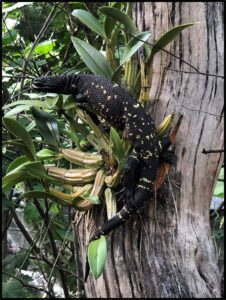
An adult Guatemalan beaded lizard, photographed at the Heloderma Natural Reserve, Guatemala.
Fans of Zoo Atlanta will know that the Guatemalan beaded lizard (GBL; Heloderma charlesbogerti) has been a primary focus of ours in terms of conservation, breeding, and research since 2000, when the founders for our successful breeding program were donated to us by the herpetologist who originally discovered and formally named the species (Dr. Jonathan Campbell, retired from University of Texas at Arlington). So much has happened in the last 26 years! We have elucidated the secrets of breeding them successfully (which was not easy; they keep their secrets well), and we raised much of the funding for the Heloderma Natural Preserve in Guatemala, which also leads the very impactful local conservation-education and citizen-science efforts within their native range. We sent offspring produced here to our partners at Parque Zoológico Nacional La Aurora, the national zoo in Guatemala City, to bolster their conservation-breeding program (which produced several babies this year!). And, along the way, we conducted a whole series of projects to learn the basic biology of this elusive species.
I’m really proud of the research we’ve done with them, so I will shamelessly brag about it a bit, including the cool results of our most recent publication. I compiled a bibliography of every scientific paper ever published on this species, and the numbers speak for themselves!
- Total number of publications on GBL: 26
- Publications by Zoo-Atlanta staff: 12
- Publications by our Guatemalan research partner, Dr. Daniel Ariano-Sánchez: 11
- Publications by others (including the original naming): 3
So, it is clear that the vast majority of what is known about this endangered species is the result of the efforts of Zoo Atlanta and our Guatemalan partners. There are many ways that zoos can make a difference in species conservation and understanding, but I think it is pretty amazing and respectfully boast-worthy to highlight our significant contributions toward this species. We have forged ahead in protecting land and supporting local educational programs, created and managed the zoological breeding program, documented aspects of their breeding physiology and behaviors, cognition and memory and sensory systems, and determined their entire genome and biogeographic history. Wow. That’s a lot. And, we are not done! There are two more projects just nearing completion (you’ll hear about those later this year) and just last week, we published a paper that was led by former Zoo Volunteen Isabelle Elliott, with Robert Hill and myself, plus Dr. Rowland Griffin (Head of Conservation and Herpetology Curator at La Aurora) and Dr. Daniel Ariano-Sánchez.
In our most recent work (citation and link below), we were curious about the subtle anatomical differences between males and females. It is difficult for anyone who has not spent enormous amounts of time with this species to visually distinguish males from females. The original taxonomic description by Campbell and Vannini (1988) suggested that females may have a cluster of enlarged scales just in front of their vent (= cloaca = butt) that males lack. But they were very careful to qualify this rather unusual finding by reporting that they only had seven individuals available to examine. Because we have access to a much larger number of individuals at Zoo Atlanta and La Aurora, we determined that their claim was partially correct and that their cautionary statement was warranted. Indeed, all females have the enlarged scales, but some males also have them. So, if they are absent, you know you have a male. If they are present, you cannot be sure what you have. So, this is interesting but not very helpful to field biologists trying to determine which sex they have found! However, an idea came to us from an unusual paper concerning copperhead snakes (coincidentally, authored by former Zoo Atlanta Curator of Herpetology Dr. Gordon Schuett) that reported the very, very unexpected result that male copperheads have longer forks on their tongues than do females. Wow, that is weird. The next time I see Dr. Schuett, I must ask “What in the world made you think to even investigate that possibility?!?!”
We decided to investigate possible differences in the tongues between the sexes, as we realized that every time you interact with these lizards (e.g., to take a picture of their belly scales) they always start flicking their tongues, so we photographed their tongues along with a scale-bar ruler and a color-standard guide. To our amazement, we found that male GBL also have longer forks than females. The difference is subtle, so also not useful to a field biologist, but the implications are fascinating! Why do males have longer forks? Dr. Schuett suggested that male copperheads use the increased surface area of their tongue to improve their abilities to track the scents of females during the breeding season. No one has tested that hypothesis, but we believe the same may be true in GBL. We already know, based on work here led by former Herpetology Keeper Noah Carl (Carl et al., 2024), that scent is a crucially important sensory cue that males use to distinguish and locate females. The next step will be to figure out a way to properly test this hypothesis. So now we’ve added it to the “To-Do List”! Our analyses of the coloration of the tongues revealed no difference between the sexes. In the meantime, if you want to know if a GBL is a male or female, you just need to show it to Robert Hill or Drs. Ariano-Sánchez or Griffin—that’s what I do, anyway!
I hope my somewhat boastful review here helps all of our guests, Members, team, Volunteers, and Docents feel proud for supporting Zoo Atlanta. This is yet another example, I believe, of Zoo Atlanta really making a difference. How many zoos can rightfully claim that their efforts and collaborative programs are responsible for the conservation programs and almost 100% of what is known about a particular endangered species? Indeed, we have lots to be proud of as the status of this endangered lizard continues to improve in the wild, while we continue to learn the secrets of their biology. Come visit us and watch for the tongues on our GBL, now that you have never been more interested in lizard tongues in your life!
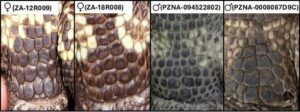
Close-up photos of the scales immediately in front of the vent, with two females (with enlarged scales) on the left and two males (one with enlarged scales on the right).
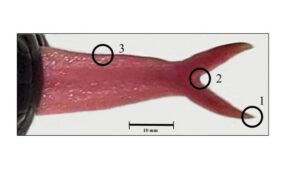
One of our data-photos, clearly showing the tongue fork (note the scale bar) and the three circles mark where we digitally collected coloration values for analyses (color-standard bar edited out of this image).
Reference:
Campbell, J.A. and Vannini, J.P. 1988. A new subspecies of beaded lizard, Heloderma horridum, from the Motagua Valley of Guatemala. Journal of Herpetology 22(4): 457-468.
Carl, N. J., Paul, J. S. and Mendelson III, J.R. 2024. Smell and tell: Behavior associated with chemosensory stimuli in Guatemalan Beaded Lizards (Heloderma charlesbogerti). Herpetological Conservation and Biology 19:1–12.
Elliott, I. E., R. L. Hill, R. K. Griffin, D. Ariano-Sánchez, and J. R. Mendelson III. 2026. Assessing tongue and preanal-scale morphology as indicators of sexual dimorphism in Guatemalan Beaded Lizards (Helodermatidae: Heloderma charlesbogerti). The Southwestern Naturalist 70: 1–8.
You can also get a copy of the original paper here:
www.researchgate.net/publication/407286410_ASSESSING_TONGUE_AND_PREANAL-SCALE_MORPHOLOGY_AS_INDICATORS_OF_SEXUAL_DIMORPHISM_IN_GUATEMALAN_BEADED_LIZARDS_HELODERMATIDAE_HELODERMA_CHARLESBOGERTI
Joe Mendelson, PhD, Director of Research
Connect With Your Wild Side #onlyzooatl